
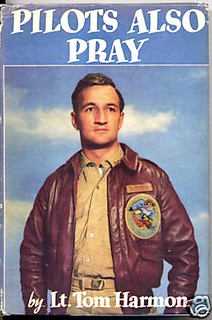
Published in 1944, “Pilots, Also Pray” is a unique and powerful text in the broader library of college football history. Its author was not a coach or a historian, but rather Tom Harmon, one of the most celebrated athletes of his generation. Harmon, Michigan’s “Old 98,” was a national icon who had won the 1940 Heisman Trophy.1 This book, however, is not about his gridiron glory. It is a raw, firsthand memoir of his service as an Army Air Forces pilot during World War II.
The book was written and published while the war was still raging, offering the American public a stunning window into the life of a man who had transitioned from sports hero to national hero. Harmon’s story was already the stuff of legend. He had famously survived two plane crashes. The first was a harrowing ordeal in the jungles of South America, which he survived alone. The second, more famous incident occurred when he was shot down during combat over China. He was rescued and protected by Chinese guerrillas, who helped him evade Japanese patrols and return to safety.
“Pilots, Also Pray” captures these experiences with a direct, humble, and serious tone, as reflected in the title. The book’s connection to college football history is profound. It serves as a primary-source document illustrating the immense cultural role that football stars played during this era. Like Nile Kinnick, who also died in service, Harmon was a symbol of an entire generation of athletes who traded their helmets for military caps. This book is a powerful reminder of a time when the game’s greatest figures were part of a much larger global conflict, proving their courage far beyond the playing field. 🏈